Since Europeana is currently supporting capacity building and workflow creation towards a framework for 3D cultural heritage objects, we at OpenUp! also want to make a contribution. One of our partner institutions, the Genoa University, brought the first 3D objects through OpenUp! to Europeana. Now we promote and highlight 3D objects on Europeana across different institutions by building galleries and engaging in storytelling activities.
Index
- Ursus spelaeus (Cave bear)
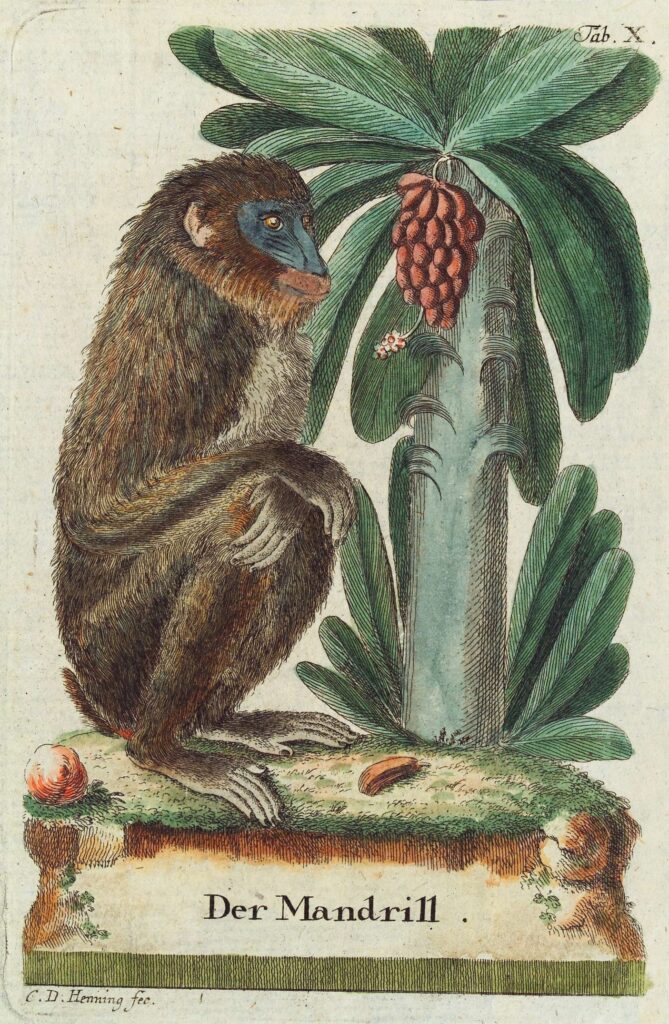
- Mandrillus sphinx (Mandrill)
- Aquila Chrysaetos (Golden Eagle)
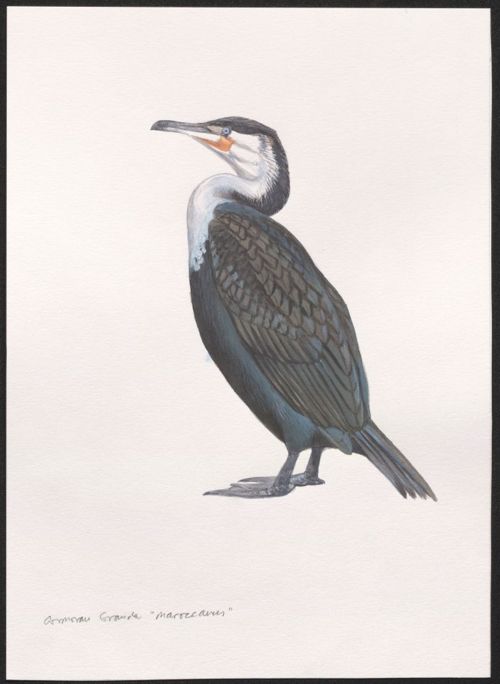
- Phalacrocorax carbo (Cormorant)
Ursus spelaeus
The first gallery was built around a 3D object depicting the right mandible of a prehistoric cave bear. The bear developed 400.000 to 500.000 years ago and became extinct after the last ice age 13.000 years ago. He was an omnivore but probably preferred plants over meat. His next relatives today are the brown bear and the ice bear.

The cave bear owes his name to the location where most of his remains were found. While he may be similar to the brown bear in basic looks, he was bigger, heavier and less adaptable to changes in nutrition and environment. That could be the reason of its extinction, though the impact of humans taking over his habitat can’t be ruled out entirely.
Ursus spelaeus by Silesian Museum licensed under CC BY-NC-SA
Additional Material
- Retreat and extinction of the Late Pleistocene cave bear (Ursus spelaeus sensu lato) (en)
- Ancient DNA and the Population Genetics of Cave Bears (Ursus spelaeus) Through Space and Time (en)
- A diachronic study of human-bear interactions: An overview of ursid exploitation during the Paleolithic of Germany (en)
- Johann Christian Rosenmüller und der Höhlenbär (1794-2004) „Lebensbilder“ aus 210 Jahren (de)
Mandrillus sphinx
For the second 3D gallery we chose a 3D digitized skull of a Mandrill (Mandrillus Squinx) of the Natural Science Museum of Barcelona as the central object. Mandrills are omnivores and live in Central Africa (Gabon, Kongo, Guinea, Kamerun). The males are known for their red and blue colored spots in the face and behind region. Their patriarchal social and behavioral system is quite complex. They live in groups of 15 to 20 individuals.
Next to the distinguished facial colours, the mandrill also stands out through his strong jaw and yellow goatee. In their natural habitat the groups often undertake distances up to 4,5 km to find enough food. In a controlled surrounding the mandrill can reach an age of up to 46 years. Today, the animal species is already highly endangered because of their habitat gradually growing smaller through human impacts and the influences of hunting.
Der Mandrill. by Herzog August Bibliothek licensed under CC BY-SA
Additional Material
- Mandrill: National Geographic (en)
- Africa geographic stories (en)
- New England Primate Conservacy (en)
Aquila chrysaetos
In our next gallery we wanted provide a combination of the different datatypes featured on Europeana. For that reason we chose the Golden Eagle (Aquila chrysaetos) that is presented by two different 3D objects aggregated by OpenUp!. In addition, you can find images and photographs, audio and video materials, as well as artwork.
The Golden Eagle (Aquila chrysaetos) is a majestic creature, often admired for its elegance. Depictions of the Golden Eagle have a long tradition in Europe, where it has always been a symbol of freedom and nobility. You can therefore find it on stamps, in heraldry, as small figurines, or simply exhibited in natural history museums.
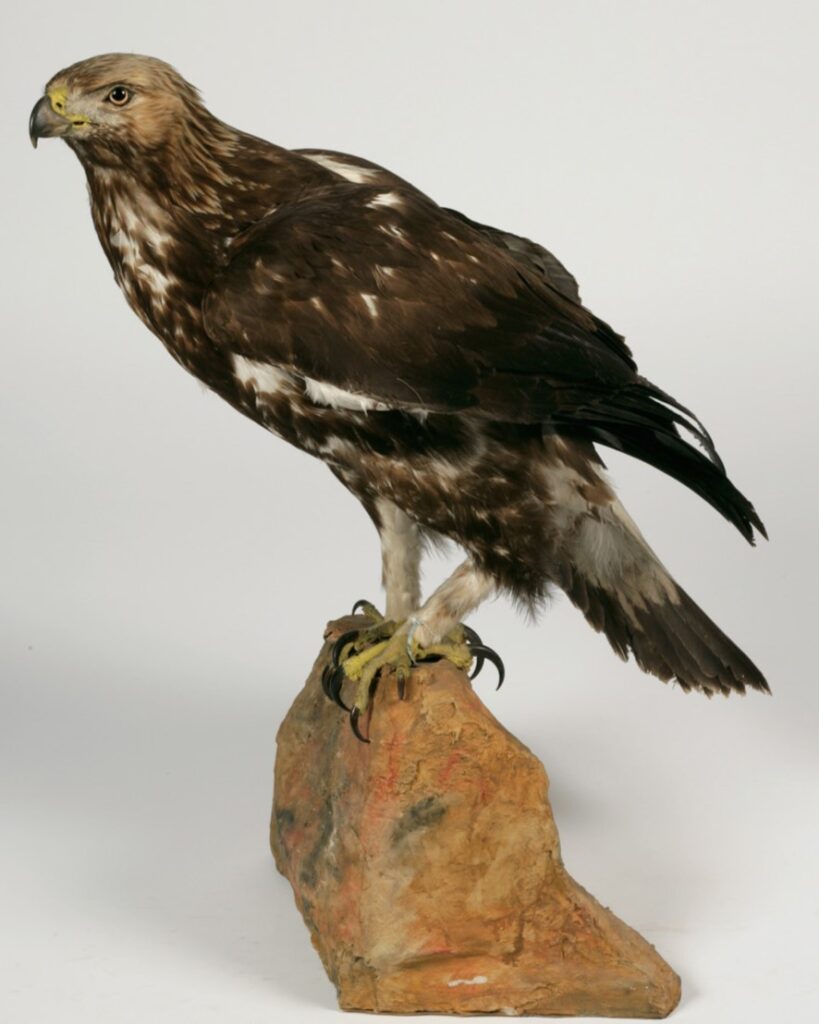
Like other birds of prey, the species was subject to intensive hunting until the 20th century. In consequence, the population underwent a decline but then stabilised over time. Its preferred habitats are the alpine regions and high plateaus. These days, the Golden Eagle of Middle Europe can mainly be found in the Alps.
Aquila chrysaetos (Linnaeus, 1758) by Natural Science Museum of Barcelona, Spain licensed under CC BY-NC
Additional Material
- Complex effects of habitat loss on Golden Eagles Aquila chrysaetos (en)
- Max-Planck-Gesellschaft: Fliegen wie ein Adler (de)
- Der Steinadler in den Alpen – Lebensweise und Schutz (de)
Phalacrocorax carbo
The cormorant (Phalacrocorax carbo) brings our 3D series to a close. The gallery contains two 3D models: a complete skeleton and a skull. This fish-eating bird is an accomplished diver and can be found throughout Europe, parts of Asia, and North America, where it lives and hunts in rivers, lakes, and coastal areas. Despite being a highly endangered species, there are repeated calls from industry and fisheries for increased management.
Male and female cormorants look the same. They live in colonies and use trees, rocks, and secluded ground spots for breeding. With a diving depth of 30 metres and a diving duration of up to 1.5 minutes, the black bird really sets the bar.
Cormorants do not oil their feathers to reach greater depths when diving for food. As a result, the bird has to dry its wings after hunting by opening them widely and resting for a while.
Cormorán grande – Phalacrocorax carbo maroccanus by Spanish National Research Council licensed under CC BY-NC-SA